

Here's a question that might surprise you: What gets you the job in STEM, but doesn't keep you there?
Answer: Your technical skills.
Wait, what? Aren't coding chops, math genius, and engineering prowess the whole point of a STEM career?
Yes and no. Those hard skills are absolutely your ticket in the door. They're what get your resume noticed, what ace you through the technical interview, what land you that first position. But here's the thing nobody tells you at graduation: your soft skills are what determine whether you're still there in five years, ten years, or whether you're leading the entire team.
Let's talk about why the skills they don't teach in calculus class might be the most valuable ones you'll ever learn.
Breaking the Myth of the "Lonely Genius"
We've all seen the movie version of the STEM professional: a solitary genius hunched over a computer in a dark room, solving impossible problems alone at 3 AM, socially awkward but brilliant beyond measure.
Here's the reality check: That stereotype is outdated, unrealistic, and honestly, kind of harmful.

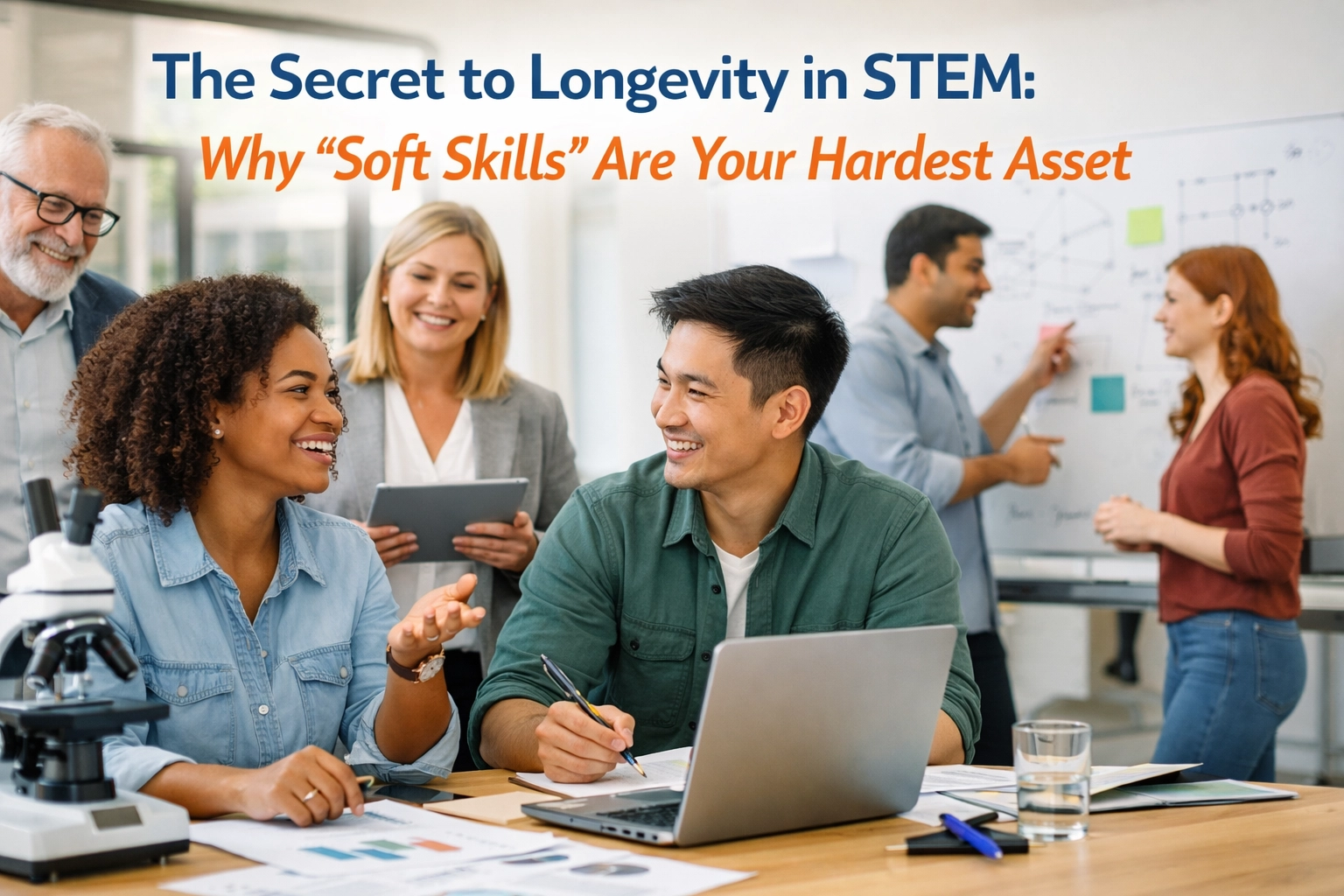
Modern STEM work is fundamentally collaborative. Whether you're coding an app, designing a bridge, researching climate solutions, or developing medical technology, you're working with teams. You're presenting ideas to stakeholders who might not understand the technical details. You're explaining complex concepts to clients. You're negotiating with other departments. You're mentoring junior colleagues.
Research shows that STEM methods don't just build technical knowledge: they actively foster communication, teamwork, problem-solving, and critical thinking, with significant measurable impact. The best engineers, data scientists, and researchers aren't just the smartest people in the room. They're the best listeners, the clearest communicators, and the most effective collaborators.
The lonely genius might solve one problem brilliantly. But the collaborative professional? They build systems, lead teams, and create solutions that scale.
Communication: Being Understood, Not Just Being Right
Let's get real for a second. You can have the most elegant solution, the most efficient algorithm, the most innovative design: but if you can't explain it to someone else, it doesn't matter.
Communication in STEM isn't about dumbing things down. It's about translation. It's about meeting people where they are and building bridges between different levels of understanding.
Think about it:
- Can you explain your project to your grandmother?
- Can you present your findings to executives who care about ROI, not just technical excellence?
- Can you write documentation that your teammates can actually understand?
- Can you take criticism without getting defensive?

Here's something that catches many STEM professionals off-guard: being right isn't enough. If you can't communicate why you're right, if you can't bring others along with your thinking, your brilliant solution stays trapped in your head: or worse, gets ignored because someone else explained their decent solution better.
Strong communication means:
- Writing clear, concise emails
- Presenting complex ideas with clarity
- Active listening (really hearing what others are saying, not just waiting for your turn to talk)
- Giving and receiving constructive feedback
- Adapting your message for different audiences
These aren't "nice-to-have" skills. In today's STEM workplace, they're essential.
Empathy and Teamwork: Why the Best Engineers Are the Best Listeners
Here's a truth bomb: Technical problems are almost never just technical problems.
Every project involves people. Every solution affects people. Every team dynamic shapes the outcome. And understanding people: their motivations, their concerns, their perspectives: that's where empathy comes in.
Empathy in STEM means:
- Understanding the end-user's actual needs (not just what you think they need)
- Recognizing when a teammate is struggling and offering support
- Appreciating different working styles and approaches
- Building psychological safety so people can take risks and innovate
- Seeing the human impact of your technical decisions

The engineer who listens to customer complaints and actually hears the underlying problem creates better products. The data scientist who understands the ethical implications of their algorithms builds more responsible AI. The researcher who values diverse perspectives on their team generates more innovative solutions.
Employers are catching on. When companies evaluate STEM candidates, they're increasingly prioritizing interpersonal competencies alongside technical abilities. New graduates often have the hard skills but lack these crucial soft skills: and that gap can make or break their career trajectory.
Teamwork isn't about being nice. It's about being effective. It's recognizing that diverse teams solve problems better, that collaboration beats competition, and that the best innovation happens when people feel heard, valued, and empowered to contribute.
Adaptability: Your Best Skill in a Fast-Changing World
Pop quiz: What technical skill you learn today will still be relevant in ten years?
Tough to say, right? That's because the STEM landscape changes fast. New programming languages emerge. Tools become obsolete. Industries get disrupted. Technologies evolve.
Here's what won't change: your ability to learn new things.
Adaptability is your superpower in STEM. It's what keeps you relevant when technologies shift. It's what helps you pivot when projects change direction mid-stream. It's what allows you to embrace new methodologies instead of clinging to "the way we've always done it."

Adaptable professionals:
- Stay curious and continuously learn
- Embrace change instead of resisting it
- Recover quickly from setbacks
- See failures as learning opportunities
- Remain flexible when plans shift
- Transfer skills across different contexts
The research backs this up: professionals who develop strong social-emotional skills and maintain adaptability throughout their careers show significantly stronger long-term success. Technical expertise might get you started, but your capacity to grow, evolve, and adapt determines how far you'll go.
Leadership: The Natural Next Step
Here's something they don't always tell you: soft skills are leadership skills.
As you advance in your STEM career, the work becomes less about what you can do and more about what you can enable others to do. Leading a team. Mentoring juniors. Shaping strategy. Building culture. Driving innovation.
None of that happens through technical skills alone. It happens through:
- Emotional intelligence
- Clear communication
- Empathy and understanding
- Collaboration and consensus-building
- Adaptability and vision
- Critical thinking about problems beyond the technical
The most successful STEM leaders aren't necessarily the most technically brilliant. They're the ones who can inspire teams, navigate complex human dynamics, communicate vision, and create environments where innovation thrives.
The Bindralearning Difference: Building Skills That Last
At Bindralearning, we get it. Technical skills are crucial: absolutely. But they're not enough.
That's why our STEMtrak4USA program doesn't just teach you to code, calculate, or engineer. We're building the whole professional. We're developing the character and capabilities you need for long-term success.
We focus on:
- Real-world collaborative projects that build teamwork skills
- Presentation opportunities that strengthen communication
- Mentorship that develops emotional intelligence
- Problem-solving that requires creativity and adaptability
- Leadership opportunities that build confidence
Because we know that your career trajectory isn't just about what you know. It's about who you are, how you work with others, and your capacity to grow.
Your Next Move
The tech might change, but the human skills? Those are forever. Start building them now. Practice active listening in your next group project. Present your ideas clearly. Seek feedback and actually use it. Be the teammate who lifts others up. Stay curious. Stay adaptable. Stay human.
Your technical skills will open doors. But your soft skills: your ability to communicate, collaborate, empathize, and adapt: those are what will build your career, earn you leadership opportunities, and create lasting impact.
Ready to develop both the technical excellence and the character that STEM careers demand? Learn more about how Bindralearning's STEMtrak4USA program prepares students not just for their first job, but for a lifetime of growth, leadership, and meaningful contribution.
Because in STEM, your hardest asset isn't your technical skills. It's your humanity.