
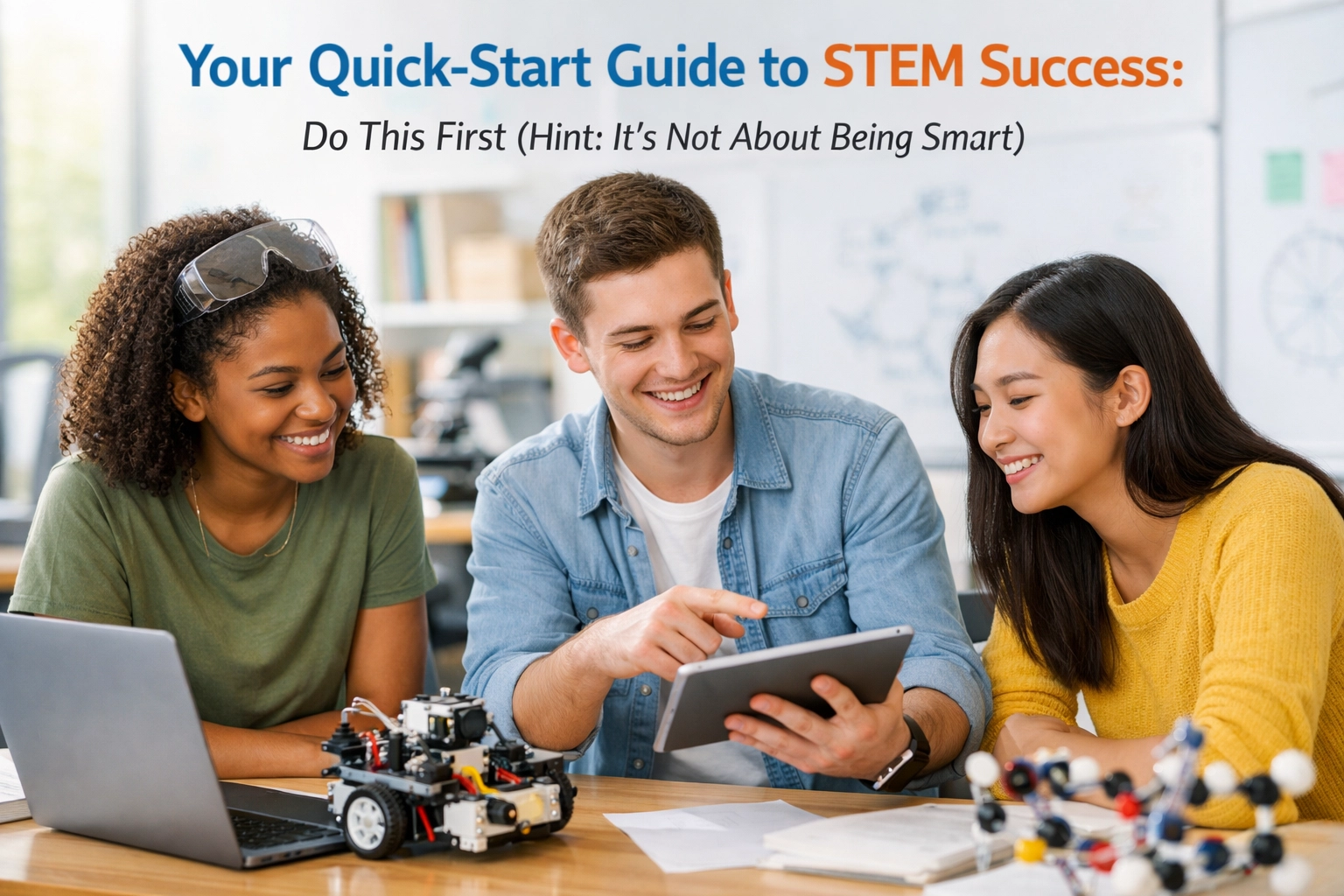

Let's get something straight right now: STEM success has nothing to do with being born a genius.
If you've been sitting on the sidelines of science, technology, engineering, or math because you think you're "not smart enough," you've been sold a lie. The truth? The people crushing it in STEM aren't walking around with higher IQs or magical brain powers. They're just doing a few things differently: and you can start doing them today.
This isn't about memorizing formulas or pulling all-nighters. It's about three simple steps that have nothing to do with how "naturally gifted" you are. Ready? Let's break it down.
Step 1: Find Your "Why" (What Problem Do You Want to Solve?)
Before you dive into textbooks or online courses, ask yourself one question: What problem do I actually care about?
Not what looks good on a resume. Not what your parents think is impressive. What gets you fired up?
Maybe you're frustrated by how long it takes your phone to charge. Maybe you're curious about climate change. Maybe you wonder why some buildings survive earthquakes and others crumble. Maybe you just want to understand how your favorite video game was built.

Here's the thing: STEM isn't some abstract subject you study in a vacuum. It's a toolkit for solving real problems. And when you connect what you're learning to something you genuinely want to figure out, everything changes. Suddenly, physics isn't boring: it's the key to understanding why roller coasters don't fly off the tracks. Chemistry isn't just memorizing elements: it's understanding why certain foods taste the way they do.
Your "why" is your compass. It keeps you going when things get tough (and they will). It makes the learning feel purposeful instead of pointless.
Action step: Spend 10 minutes today writing down 3-5 things in your daily life that make you wonder "how does this work?" or "why is this like this?" That's your starting point.
Step 2: Build a Habit of Curiosity (Ask "How Does This Work?")
Once you've identified what you care about, the next step is deceptively simple: start asking questions.
Not just any questions: curious questions. The kind a five-year-old asks that drives adults crazy: "But why?" "But how?"
Here's what most people get wrong: They think STEM learning happens in classrooms or labs. Wrong. STEM learning happens everywhere, all the time. You're surrounded by it.
- Why does your Wi-Fi get slower when everyone's home?
- How does Netflix know what to recommend to you?
- Why do some fabrics keep you warmer than others?
- How does your phone's camera focus so fast?

The secret to STEM success is recognizing that STEM is already part of your everyday life. You don't need expensive equipment or a college degree to start learning. You just need to notice what's around you and get curious about it.
Make Curiosity a Daily Practice
Here's how to turn curiosity from a random spark into a consistent habit:
Start small. Pick one thing each day that you use or interact with, and spend 5 minutes researching how it works. Google it. Watch a YouTube video. Read a Reddit thread. You're not trying to become an expert: you're just scratching the surface of understanding.
Ask out loud. When something confuses you, say it: "I wonder how that works?" Even if no one's around. Verbalizing curiosity makes it real. It signals to your brain that this is something worth figuring out.
Connect to what you love. Love cooking? That's chemistry. Love gaming? That's coding, physics, and design. Love sports? That's biomechanics and data analysis. STEM isn't separate from your interests: it's hiding inside them.
The research backs this up: critical thinking, creativity, problem-solving, collaboration, and adaptability: the skills that actually drive STEM success: are all learnable. They grow stronger the more you practice asking questions and seeking answers.
Step 3: Get a Roadmap (Don't Wander Aimlessly)
Curiosity gets you started. But here's where a lot of people stall out: they don't know where to go next.
You've asked a bunch of questions. You've watched some videos. You're interested. But now what? Do you learn coding? Take a physics class? Build something? It's easy to feel overwhelmed and end up doing nothing.
This is where having a roadmap changes everything.

Think about it: If you wanted to drive across the country, you wouldn't just start driving randomly and hope you end up in the right place. You'd use GPS. You'd plan your route. You'd figure out where to stop along the way.
STEM learning works the same way. You need guidance. You need structure. You need someone who's been there before to show you the path.
Why Structure Matters (Especially at the Beginning)
When you're starting out, too much freedom is actually the enemy. Unlimited options lead to paralysis. You waste time jumping between random tutorials, never building real momentum.
What you need is a clear progression:
- Start here
- Then do this
- Now try that
- Here's where it gets challenging
- Now you're ready for this next level
That's exactly what programs like STEMtrack4USA were designed to do. Instead of wandering through STEM topics aimlessly, you get a clear pathway that meets you where you are and takes you where you want to go.
What a Good STEM Roadmap Includes
Here's what to look for when you're choosing a program or resource:
1. A clear starting point. No matter your background, you should know exactly where to begin.
2. Progressive challenges. You should feel stretched, but not overwhelmed. Each step should build on the last one.
3. Hands-on learning. STEM isn't a spectator sport. You need to do things, not just watch videos or read articles.
4. Real guidance. Not just content: actual mentorship from people who know the field and can answer your questions.
5. Community. Learning alongside others keeps you motivated and accountable.
At Bindralearning, we've built our programs around these principles because we've seen what works. Whether it's through STEMtrack4USA or our other courses, the goal is always the same: give you a structured path forward so you're not figuring everything out alone.

The Bottom Line: Smart Is Something You Become, Not Something You're Born With
Let's circle back to where we started: You don't need to be a genius to succeed in STEM.
What you need is:
- A reason that matters to you (your "why")
- A habit of asking curious questions
- A clear roadmap to follow
That's it. That's the formula.
Everything else: the knowledge, the skills, the confidence: comes from showing up consistently and doing the work. Not because you're naturally brilliant, but because you're curious and committed.
STEM isn't a members-only club for people with high IQs. It's a set of tools that anyone can learn to use. And the world needs more people who are willing to pick up those tools and build something.
Ready to Start Your STEM Journey?
If you're tired of feeling like STEM is for "other people" and you're ready to take that first step, Bindralearning has your back.
Our programs are designed for real people: people who are curious, motivated, and ready to learn, regardless of where they're starting from. Whether you're exploring STEM for the first time or looking to level up your skills, we'll give you the roadmap and support you need.

Check out STEMtrack4USA to see how we're helping students like you turn curiosity into capability. Or explore our other courses to find the right fit for your goals.
The genius myth ends today. Your STEM journey starts now.
What's one question you're curious about right now? Drop it in the comments( let's figure it out together.)