


When you hear the word "STEM," what’s the first thing that pops into your head? For a lot of people, it’s a high-tech lab in Silicon Valley, a rocket launching from Cape Canaveral, or maybe a genius in a hoodie hunched over a keyboard writing complex algorithms for a social media giant.
Those things are cool, don't get me wrong. But for many of us, especially those of us in underserved communities, that version of STEM feels a million miles away. It feels like something "other" people do. It feels like a career path that requires a golden ticket or a fancy zip code to even get an invite.
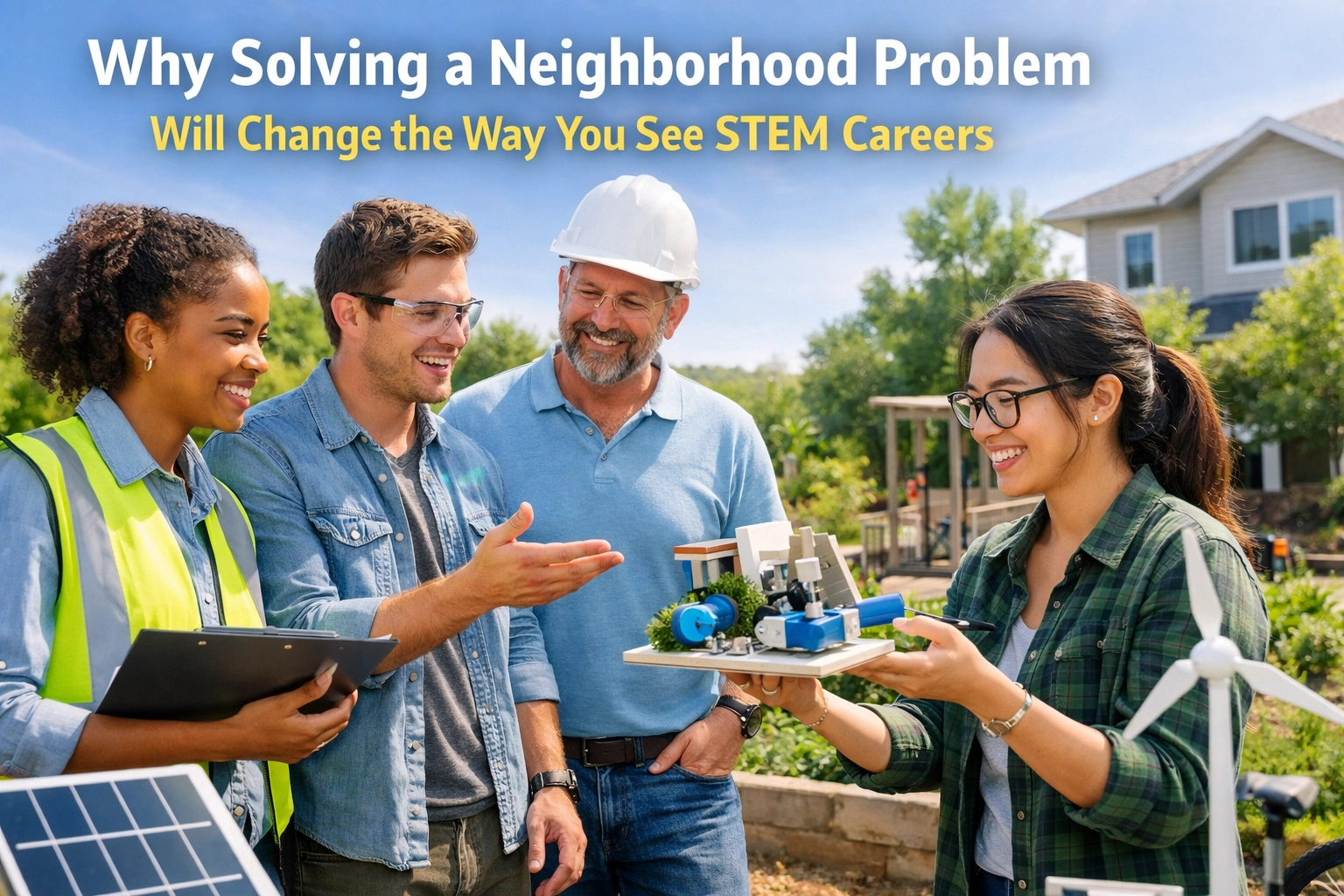
Here at Bindralearning Inc., we’re on a mission to flip that script. We believe that the most powerful STEM work doesn’t happen in a sterile lab, it happens in your own backyard. It happens when you look at a problem in your neighborhood and say, "I can fix that."
Solving a neighborhood problem won't just help your community; it will completely transform how you see yourself and your future career. Let’s talk about why.
1. It Turns "Abstract" into "Actionable"
In school, STEM can sometimes feel like a series of abstract puzzles. Why am I learning this calculus formula? Why does this chemical reaction matter? When you’re just solving problems in a textbook, it’s easy to lose interest.
But everything changes when you apply those same concepts to something you see every day.
Imagine looking at the recycling habits in your apartment complex. Maybe you notice that half the "recycling" bin is actually just trash because people don't know what goes where. Using data collection (Science/Math) to track the waste and then designing a simple QR-code-based app (Technology/Engineering) to show residents what’s recyclable in real-time isn’t just a school project. It’s a solution.
When you solve a local problem, STEM stops being a subject and starts being a tool. It’s like the difference between reading a manual about a hammer and actually using that hammer to build a shelf for your room. Once you see the impact, you’ll never see "Science" as just a class again.

2. Empathy: The Secret Ingredient of Great Engineering
One of the biggest misconceptions about STEM careers is that they are "cold" or "robotic." People think it’s all about logic and no heart.
The truth? The best engineers, scientists, and coders are the ones with the most empathy.
When you decide to tackle a neighborhood issue, like mapping "food deserts" in your city, you aren't just looking at coordinates on a map. You’re thinking about the grandmother three doors down who has to take two buses just to buy fresh broccoli. You’re thinking about the kids who only have access to processed snacks at the corner store.
By focusing on local issues, you build a deep sense of civic responsibility. You learn to ask: Who is this for? How will this make their life easier? This empathy-first approach is exactly what top tech companies are looking for today. They don't just want people who can code; they want people who understand the human impact of the code they write.
You can learn more about how we foster this mindset through our mission at Bindralearning Mission and Vision.
3. Breaking the "Identity" Barrier
Representation matters. A lot. If you don't see people who look like you or come from your background in STEM roles, it’s hard to imagine yourself there.
However, research shows that when students from underrepresented groups engage with data and technology to solve problems in their own lived experiences, their "STEM identity" skyrockets. You start to see that STEM professionals aren't just people in white lab coats; they are people who solve problems. And since you are solving problems in your community, you are a STEM professional.
By mapping out local resources or coding a website for a neighborhood charity, you shatter the stereotype of who belongs in tech. You realize that your background and your unique perspective are actually your greatest strengths. You see things that a developer in a high-rise office might miss.

4. Building a "Standout" Portfolio
Let’s get practical for a second. Whether you’re applying for a scholarship, a college program, or your first internship, you need a way to stand out.
Every student has a GPA. Lots of students have high test scores. But how many students can say, "I noticed that the local soup kitchen was struggling to track their inventory, so I built them a database system that reduced food waste by 20%"?
That is a "mic drop" moment in an interview.
A project that solves a real-world, local problem demonstrates:
- Initiative: You didn't wait for someone to give you a task.
- Problem-Solving: You identified a pain point and found a solution.
- Technical Skill: You applied what you learned to a real environment.
- Communication: You had to talk to neighbors, charity directors, or local leaders to make it happen.
At Bindralearning Inc., we encourage this kind of hands-on learning through programs like STEMTRAK4USA. It’s about building a portfolio that has a heartbeat.
5. You Realize You Don't Need Permission
For a long time, education was about "gatekeeping." You had to wait until you had a degree or a specific job title to make a difference.
The digital age has changed all of that. You don't need permission to be an agent of change.
If there’s a local charity that needs a better way to sign up volunteers, you can learn the basics of web development and build it for them. If there’s a local park that’s always flooded, you can use basic environmental science and engineering principles to propose a drainage solution to your city council.
A 2023 study found that participating in these kinds of "extracurricular" STEM activities has a direct correlation with a student’s interest in a STEM career. Why? Because it’s empowering. It proves that you have the power to change your environment right now, not ten years from now.

How to Get Started (The "Backyard" Method)
You don't need a million-dollar grant to start. You just need to be observant. Here’s a quick roadmap:
- Walk Your Block: Take a walk through your neighborhood with a notebook. What’s frustrating? What’s broken? Is the trash pickup inconsistent? Is there a lack of green space?
- Pick One Small Thing: Don't try to solve global warming on Tuesday. Try to solve the lack of information about local food pantries.
- Ask Questions: Talk to people. "Hey, if we had an app that told you exactly when the bus was coming to this specific stop, would that help you?"
- Use Free Tools: You don't need expensive software. Use Google Sheets for data, Canva for design, or free coding platforms like Scratch or Replit to start building.
- Document Everything: Even if the project doesn't "work" perfectly, the process is what matters. Take photos, save your notes, and keep track of what you learned.
The Big Picture
At the end of the day, STEM is about more than just making gadgets. It’s about making life better. When you focus on your neighborhood, you realize that a career in STEM isn't just a way to earn a paycheck: it’s a way to serve the people you love.
It builds the critical thinking and collaboration skills that are valuable in any profession. But more importantly, it gives you the confidence to know that no matter where you go in life, you have the tools to fix what’s broken.
Are you ready to start your journey? Whether you're interested in mastering the basics through our Lightning Math Enhancement Program or looking for support through a CSCRP Scholarship, we are here to help you turn your curiosity into community impact.
Your neighborhood is waiting. What will you solve first?

Want to learn more about how we’re changing the face of education? Check out Who We Are and join the movement today!