
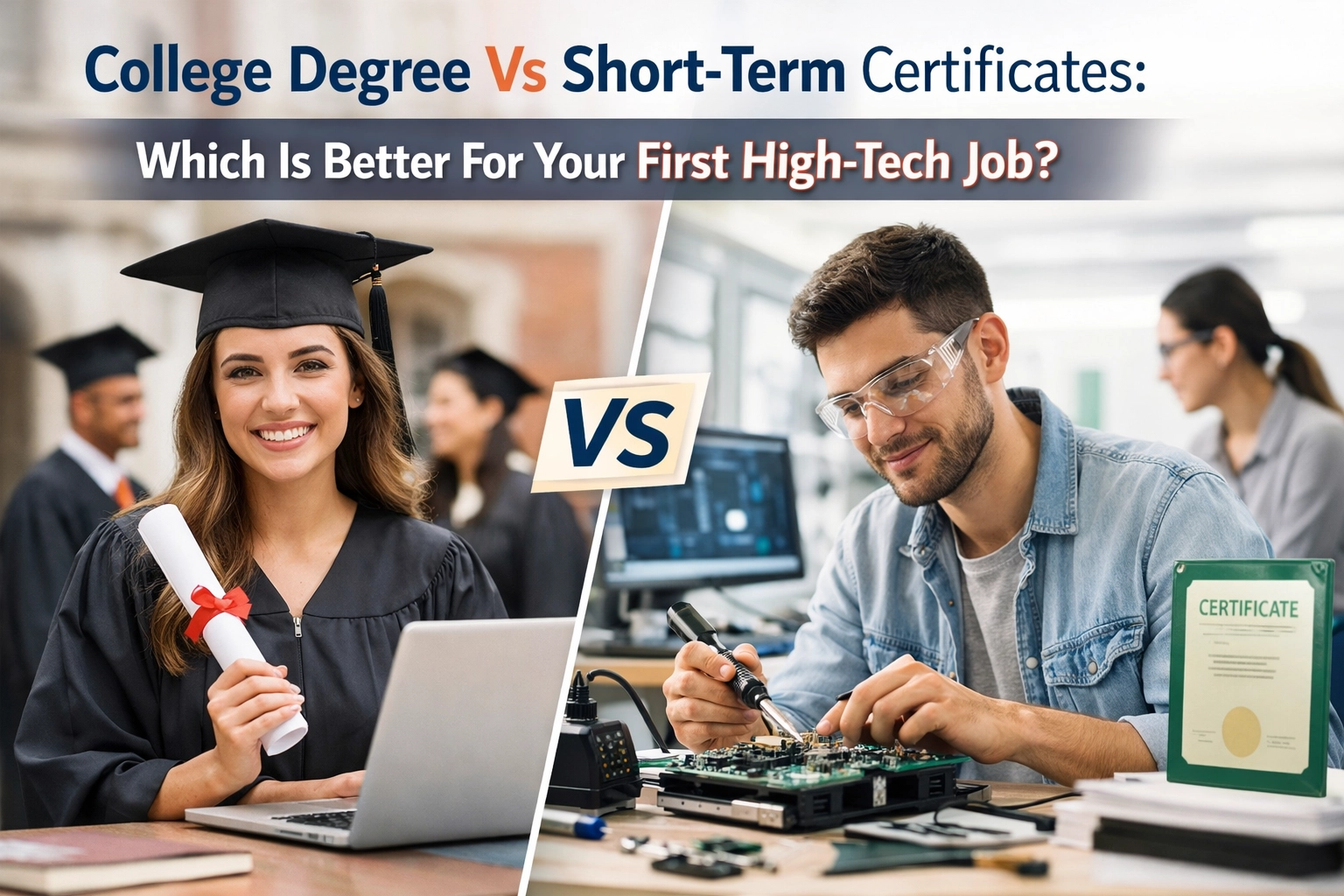

Hey there! If you’re reading this, you’re likely standing at one of the biggest crossroads of your life. Maybe you’re finishing high school, or perhaps you’re looking to pivot careers into the fast-paced world of technology. You’ve probably heard two very different stories: one where you must have a four-year degree to be taken seriously, and another where a quick three-month certificate can land you a six-figure job at a tech giant.
So, which one is it?
At Bindralearning Inc., we see this struggle every day. Especially for students from underserved communities, this isn’t just an academic question: it’s a financial and life-changing decision. You want to get into the "high-tech" world, but you also need to be smart about your time and your wallet.
Let’s break it down, keep it real, and help you figure out which path actually fits your dreams.
The Reality of the Tech Landscape in 2026
The tech world moves faster than a TikTok trend. By the time a traditional college curriculum is approved and printed in a textbook, the software it's teaching might already have three new updates. This is why the industry has become much more open to alternative forms of education.
Companies like Google, Apple, and IBM have famously removed the "degree required" label from many of their job postings. They want to know one thing: Can you do the work?
However, "can you do the work" and "can you lead the company" are two different things. This is where the debate between a degree and a certificate gets interesting.

Path 1: The Short-Term Certificate (The "Fast Track")
If you’re looking for the quickest way to get your foot in the door, certificates are your best friend. These are typically focused, high-intensity programs that teach you a very specific skill set: like Cybersecurity, Data Analytics, or Cloud Architecture.
The Pros
- Speed to Employment: Most certificate programs take anywhere from three months to a year. If you need to start earning a "tech-sized" paycheck sooner rather than later, this is the way to go.
- Affordability: Compared to the cost of a four-year university, certificates are a fraction of the price. For students in underserved communities, this means avoiding the crushing weight of student debt.
- Laser Focus: You won’t be taking elective courses in 18th-century literature (unless you want to!). You’ll be learning the exact tools and languages that employers are hiring for right now.
The Cons
- The "Glass Ceiling": While a certificate can get you a junior-level role, some companies still require a degree for senior management or executive positions.
- Narrow Scope: You become an expert in one thing. If that specific technology becomes obsolete, you might need to head back to the classroom sooner than someone with a broad foundational degree.
Path 2: The College Degree (The "Long Game")
The traditional four-year degree (Computer Science, Information Technology, etc.) is the marathon approach. It’s a deep dive into the "why" behind the "how."
The Pros
- Foundational Knowledge: You don't just learn how to code; you learn how computers actually think. This deep understanding makes it easier to adapt to any new technology that comes out in the next 20 years.
- Networking and Social Capital: College is where you meet your future co-founders, mentors, and recruiters. For many first-generation students, the "who you know" is just as important as the "what you know."
- Long-Term Earning Power: Statistically, degree holders still tend to earn more over the course of their entire careers and have more upward mobility into leadership roles.
The Cons
- The Price Tag: Let’s be honest: college is expensive. Without scholarships or massive financial aid, it can be a huge barrier.
- Time Commitment: Four years is a long time to wait before you start earning a professional salary.

Addressing the Barriers for Underserved Communities
We believe at Bindralearning Inc. that your zip code shouldn't determine your career trajectory. Our mission and vision are centered around breaking down these exact walls.
For students from underserved backgrounds, the "certificate vs. degree" debate is often framed as a choice between "money now" or "growth later." But what if it didn't have to be?
Many of our students are finding success with a Hybrid Model. They start with a high-value certificate to get an entry-level job in tech, and then use their employer's tuition reimbursement programs to pay for their degree while they work. This way, you get the immediate income and the long-term growth without the debt.
How Do You Choose? (The Checklist)
Still feeling stuck? Ask yourself these four questions:
- What is my financial runway? If you need to support your family or yourself immediately, a certificate gets you to a paycheck faster.
- How do I learn best? Do you like deep theory and broad subjects (Degree), or do you want to get your hands dirty with practical projects right away (Certificate)?
- What is my ultimate goal? Do you want to be a specialist who is the best in the world at one specific thing, or do you want to manage teams and lead organizations?
- Do I have a support system? Navigating these choices alone is hard. That’s why we created STEMtrack4USA: to provide the mentorship and guidance needed to make these tough calls.

Why STEMtrack4USA is a Game Changer
Making this decision is heavy. You’re not just choosing a school; you’re choosing a future. Through our STEMtrack4USA program, we help students evaluate their unique situations. We look at your strengths, your financial needs, and the local job market to help you build a personalized roadmap.
Whether that roadmap leads to a coding bootcamp or a prestigious university, we are there to provide the supplemental support: like our Lightning Math Enhancement Program: to make sure you don't just get in, but you thrive.
The Power of "And," Not "Or"
The secret that the tech industry doesn't always tell you is that the most successful people are constantly learning. A degree isn't the end of your education, and a certificate isn't just a one-off.
In the tech world, you are a "forever student." You might get a degree in Computer Science [and] then get a certificate in AI three years later. You might start with a certificate in Web Development [and] then finish your degree online while working as a developer.

Final Thoughts: Your Potential is Limitless
At the end of the day, whether you have a piece of paper from a university or a digital badge from a certification provider, the high-tech world is looking for problem solvers. They are looking for people with grit, curiosity, and the drive to keep building.
If you’re feeling overwhelmed by the options, don't worry. Reach out to us. Check out who we are and see how we’ve helped others just like you navigate this exact path. You don't have to figure it out alone.
Ready to take the next step? Whether it’s applying for a scholarship or just asking a few more questions through our enquiry form, the most important thing is that you start.
The tech world is waiting for you. Which path will you take?
Want to learn more about how to boost your skills before you dive in? Explore our courses or read more about our founder’s vision for inclusive education.