
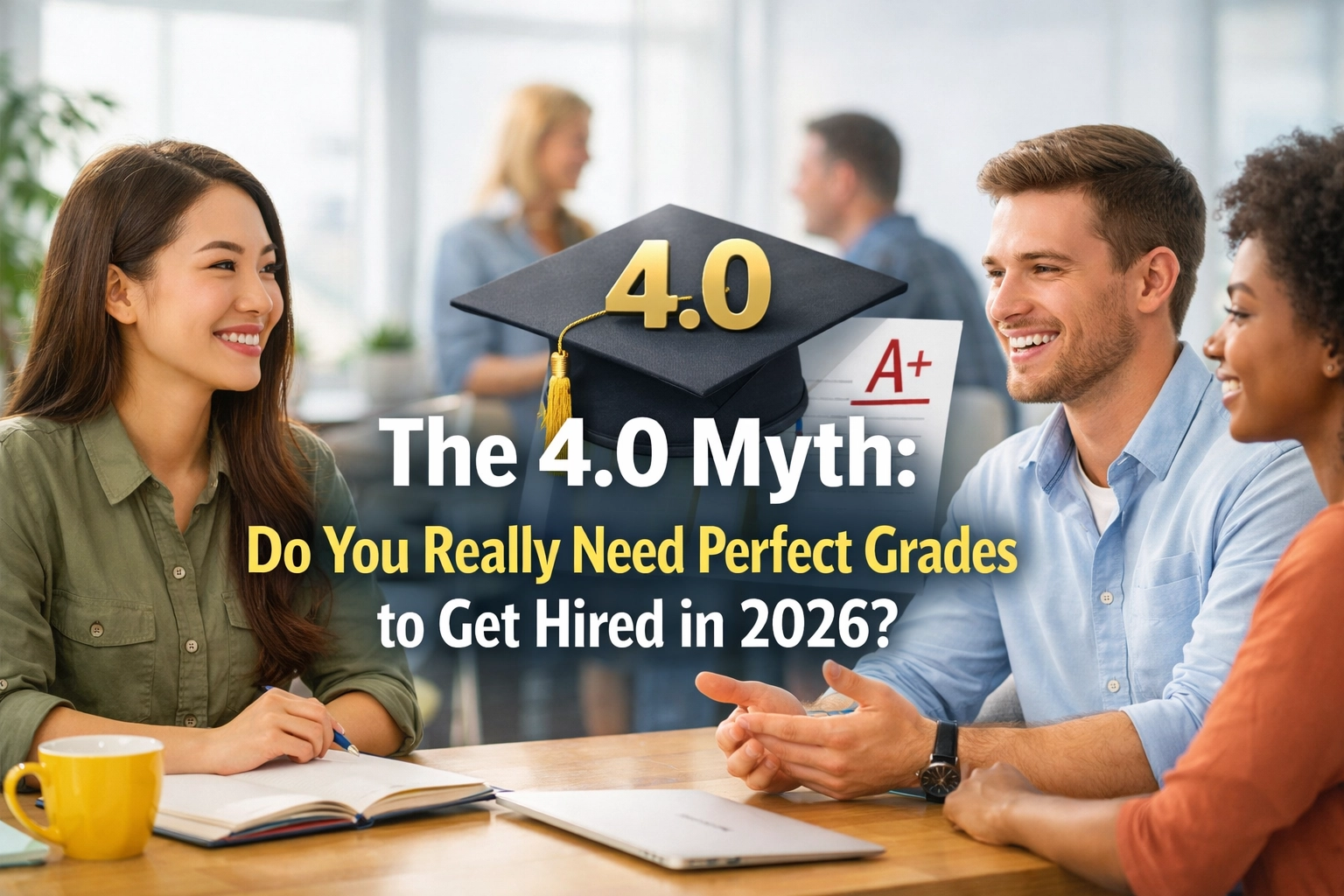

For decades, the "4.0 GPA" was the holy grail of student life. It was the golden ticket, the ultimate validation, and the gatekeeper to a high-paying career. We were told that if our grades slipped, our futures would slip with them. But as we sit here in March 2026, the landscape of the professional world has undergone a seismic shift.
If you’ve been losing sleep over a B-minus or worrying that your transcript isn't "perfect" enough to catch a recruiter’s eye, I have some news for you: The era of the GPA obsession is officially over.
At Bindralearning Inc., we believe that education is about more than just a number on a page. Our mission and vision have always been about empowering students for the real world, and the "Real World" of 2026 is finally catching up to that philosophy.
Let’s dive into why the 4.0 myth is crumbling and what actually matters when you're looking to get hired today.
The Data Doesn’t Lie: The Death of the Screening Filter
To understand how much things have changed, we only need to look at the numbers. Back in 2019, nearly 73.3% of employers used GPA as a primary screening tool to filter out candidates. If you didn't have a 3.5 or higher, your resume often didn't even make it to a human being’s desk.
Fast forward to today, March 2026. Only 42.1% of employers still use GPA as a screening tool. That is a staggering 43% decline in just seven years.
Why the sudden drop? It’s simple: employers realized that a high GPA doesn’t guarantee a high-performing employee. In fact, many companies found a "GPA gap" where candidates with perfect academic scores struggled with the messy, unpredictable nature of modern work, while those with "average" grades but high adaptability were the ones driving innovation.

Why Companies Stopped Caring About Your Grades
Major global players like Google, Apple, IBM, and Ernst & Young (EY) were among the first to realize that academic performance is a poor predictor of professional success.
Ernst & Young famously removed all academic requirements from their hiring process after conducting internal data analysis. What did they find? There was zero correlation between how well someone did in a university lecture hall and how well they managed a complex audit or a client relationship.
The traditional grading system rewards:
- Memorization: The ability to retain facts for a test.
- Compliance: Following specific instructions within a controlled environment.
- Individualism: Working solo to achieve a personal score.
The 2026 workplace, however, rewards:
- Synthesis: Combining information from different sources to solve new problems.
- Critical Thinking: Questioning the status quo to find efficiencies.
- Collaboration: Working within diverse teams (often assisted by AI) to reach a common goal.
When the two systems don't align, the "4.0" becomes a hollow metric.
The Rise of Skills-Based Hiring
If employers aren't looking at your GPA, what are they looking at? The answer is Skills-Based Hiring. Currently, nearly 70% of employers prioritize actual capabilities over academic credentials.
At Bindralearning, we see this transition every day in our courses. Companies are no longer asking "Where did you go to school?" or "What was your rank?" Instead, they are asking, "What can you build?" and "How do you solve this problem?"
The 5 Key Competencies of 2026
If you want to be competitive in today’s market, you need to focus on these five areas:
- Technical Proficiency: This isn't just about coding. It’s about your ability to use job-specific tools, whether that’s advanced data analytics, AI prompt engineering, or industry-specific software.
- Problem-Solving: Can you look at a failing process and find a way to fix it? Employers want to see evidence of your logic and your grit.
- Communication: In a world of remote work and digital interfaces, the ability to convey complex ideas clearly and empathetically is more valuable than ever.
- Adaptability: The tools we use today might be obsolete in 18 months. Are you a lifelong learner? Do you have the "learn-unlearn-relearn" muscle?
- Digital Literacy: This goes beyond using a smartphone. It’s about understanding how technology integrates into your specific field.

Portfolio Power: Why Your "Doing" Beats Your "Studying"
In 2026, your portfolio is your real resume. A candidate with a 2.9 GPA who has a GitHub full of original code, a portfolio of successful marketing campaigns, or a blog documenting their journey in a specific niche is infinitely more attractive than a 4.0 student who has only ever completed classroom assignments.
Real-world projects prove that you can handle the "friction" of reality. In a classroom, the variables are controlled. In a real project, things break, people disagree, and deadlines shift. Showing a recruiter how you navigated those challenges is the best way to prove your worth.
If you are looking for ways to build that resilience and project base, checking out resources like the Summer Resilience Checklist can give you a head start on moving beyond the transcript.
Are There Exceptions?
To be fair, the GPA isn't completely "dead": it's just no longer the primary heartbeat of hiring. In hyper-competitive entry-level pipelines: specifically in high-stakes finance, elite law firms, or specialized medical research: GPA is still used as a secondary filter. When a company receives 10,000 applications for 10 spots, they use every metric available to narrow the pool.
However, even in these fields, a "perfect" GPA will not save a candidate who lacks the core competencies mentioned above. It might get you the first interview, but it won't get you the job.
How to Win the Hiring Game Without a 4.0
If you’re currently a student or a job seeker, here is your playbook for the 2026 job market:
1. Build a Proof-of-Work: Stop telling people you are "good at Python" or "passionate about marketing." Show them. Create a website, launch a podcast, contribute to open-source projects, or take on a pro-bono project for a local non-profit.
2. Network Through Value: Instead of asking for a job, share your work. Post your insights on LinkedIn, engage with industry leaders, and show that you are an active participant in your field.
3. Focus on Specialized Learning: Traditional degrees move slowly. Supplement your education with fast-paced, skill-specific learning. Whether it's our Lightning Math Enhancement Program to sharpen your analytical mind or a certification in a new AI tool, staying current is vital.
4. Quantify Your Achievements: On your resume, replace "Maintained a high GPA" with "Increased project efficiency by 20% through the implementation of a new tracking system."

The Inspirational Truth
The decline of the GPA is actually a beautiful thing. It means the doors of opportunity are swinging wider for people who think differently, people who work harder, and people who might not fit into a traditional academic box.
It means that your worth is no longer defined by a test you took when you were 19 years old. Your worth is defined by your curiosity, your drive, and your ability to contribute to the world around you.
At Bindralearning Inc., we’ve always believed that every student has a unique trajectory. We aren't here to help you fit into a mold; we’re here to help you break it. Whether you are seeking a scholarship or just looking for advice on who we are and how we can help, we are committed to your success in this new, skills-first world.
Conclusion: Take the Pressure Off
So, is the 4.0 GPA dead? Not quite. But it’s certainly no longer the king.
If you have a 4.0, that’s great: it shows you’re disciplined and capable of excelling in a system. But don’t let it be your only selling point. And if you don't have a 4.0, don’t let it hold you back for a second. The market is looking for your skills, your heart, and your unique perspective.
Go out there and build something. Solve something. Learn something new. That is how you get hired in 2026.
If you have questions about how to navigate your educational journey or need guidance on the next steps for your career, don't hesitate to reach out to us. We’re here to help you turn your potential into reality, one skill at a time.