
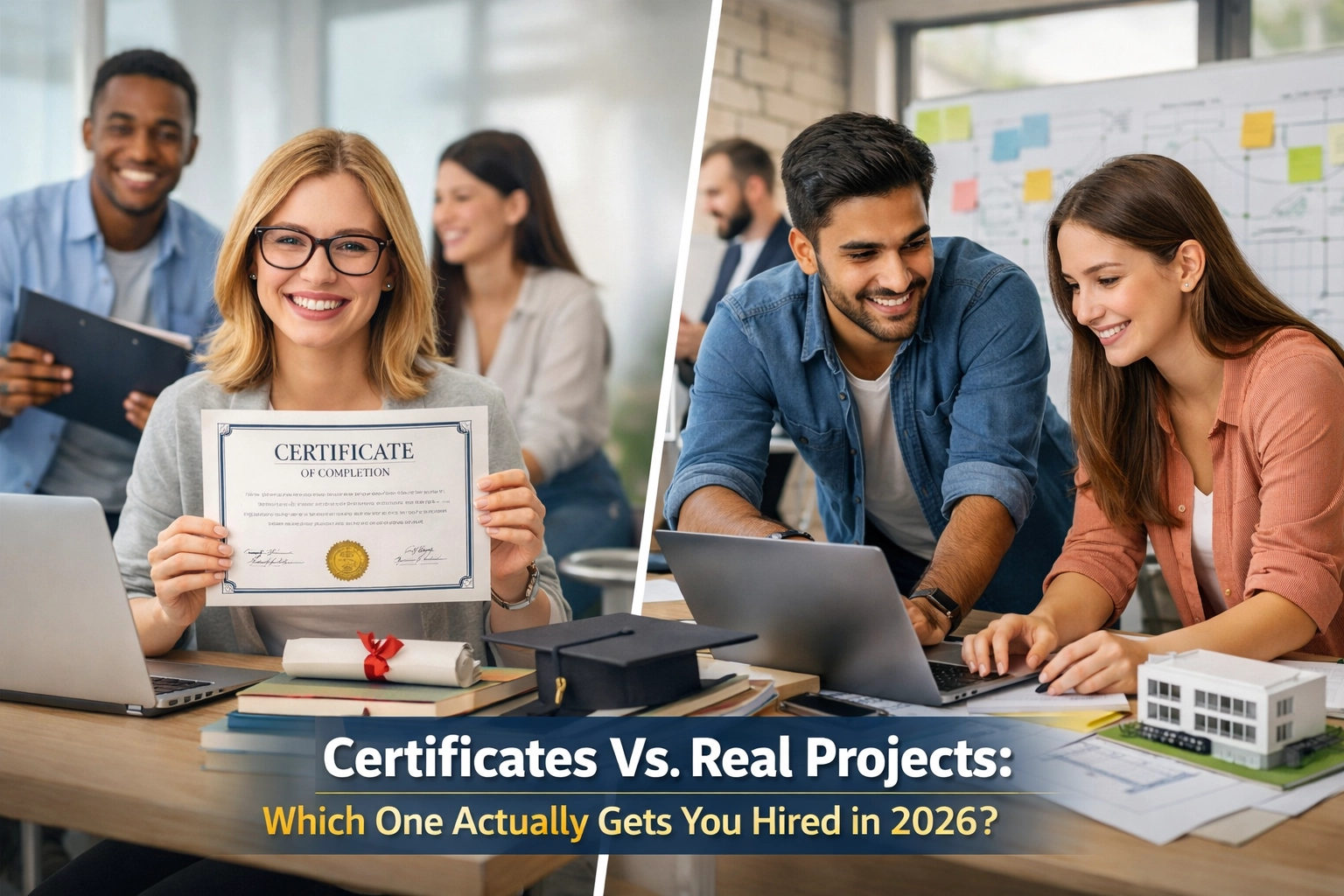

You’re staring at two tabs on your browser. One is a $400 professional certification course that promises a shiny digital badge for your LinkedIn profile. The other is a blank GitHub repository or a Trello board for a project idea you’ve been kicking around for weeks.
You’ve got limited time and even more limited energy. You’re wondering: “Which one is actually going to land me the job?”
It’s a fair question. In 2026, the tech landscape looks a lot different than it did even three years ago. With AI tools now able to pass basic certification exams and generate boilerplate code in seconds, hiring managers have become more skeptical than ever. They aren’t just looking for someone who can memorize a handbook; they’re looking for someone who can solve a problem when the documentation doesn’t have the answer.
At Bindralearning Inc., we see students wrestling with this daily. Whether you're transitioning from a different field or just starting out, the "Certificates vs. Projects" debate is the fork in the road of your tech career.
Let’s break down what’s actually moving the needle in 2026.
The Certification Trap: Why "Paper Experts" Are Fading
Don’t get me wrong, certifications have their place. If you want to work in cloud security or specialized networking, an AWS Solutions Architect or a CompTIA Security+ badge is often a baseline requirement.
But here is the hard truth: Certifications are "door openers," not "deal closers."
In 2026, a certificate proves you have the discipline to study and the ability to pass a test. It signals foundational knowledge. However, it doesn't demonstrate how you actually work. Multiple-choice exams can’t show a hiring manager how you investigate a mysterious bug at 2:00 AM, how you prioritize features under a tight deadline, or how you explain technical debt to a non-technical stakeholder.
If your resume is just a list of five different certificates with zero evidence of how you applied that knowledge, you’re telling the recruiter: "I know the theory, but I’ve never touched the tools in the wild."

The Power of the Portfolio: Why Projects Are Your Secret Weapon
If certificates are the "vocabulary," then projects are the "conversation."
A well-documented project in your portfolio tells a story. It shows the evolution of your thinking. When a hiring manager looks at a real-world project, they aren’t just looking at the final code; they are looking for:
- Problem Identification: Why did you build this? Did you solve a real pain point, or did you just follow a tutorial?
- Tool Selection: Why did you choose React over Vue? Why SQL over NoSQL? Your ability to justify your tech stack is a massive green flag.
- Resilience: Every project hits a wall. How did you get past yours?
- Communication: Can you explain your work?
In 2026, "Skills-based hiring" is the dominant trend. Companies are increasingly moving away from formal degree requirements, something we discuss in depth in our guide on STEM careers without a 4-year degree. They want to see what you can do.
A project proves you didn't just "exam cram." It proves you've wrestled with the technology and won.
The Winning Strategy for 2026: The Hybrid Approach
If you’re asking "which is better," you might be asking the wrong question. The most successful candidates in today's market don’t choose one, they combine them.
Think of it like this: The certification gets you past the automated resume filters (the "ATS"), and the project gets you through the interview.
How to Build a Hybrid Portfolio:
- Step 1: Get one foundational certification in your chosen path (e.g., Cloud, Data, or Cybersecurity). This proves you speak the language.
- Step 2: Immediately build a project that utilizes at least three core concepts from that certification.
- Step 3: Document the "Process Evidence." Don't just show the finished product. Show the sketches, the failed versions, and the "Aha!" moments. This proves you didn't just ask an AI to write the whole thing for you.
At Bindralearning, our mission and vision are centered around empowering students to bridge this gap. We believe education should be practical, not just academic.

What Counts as a "Real Project" Anyway?
Stop building "To-Do" lists and Weather Apps. Everyone has those. In 2026, you need to stand out. A "real" project is something that has a user (even if that user is just you or your mom) and solves a specific problem.
- For Web Developers: Build a custom inventory management system for a local small business or a specialized community forum.
- For Data Analysts: Scrape a unique dataset (like local transit times or niche hobby prices) and create a dashboard that predicts a trend.
- For Cybersecurity: Set up a home lab, simulate an attack, and write a professional-grade incident response report.
The key is Originality. If there are 5,000 YouTube tutorials on how to build it, it’s not a "real project" for your portfolio: it’s a practice exercise. To find more inspiration for your path, check out our list of 50 STEM pathways you can start with zero experience.
Proving You Didn't Just Use AI
This is the biggest hurdle for new techies in 2026. Because AI can generate code and summaries, you have to prove the human element of your work.
Hiring managers now look for "Process Evidence." This means:
- Commit History: A GitHub history that shows gradual progress over weeks, not one giant code dump.
- Blog Posts: Writing about the challenges you faced while building.
- Video Walkthroughs: A 2-minute video of you explaining the logic behind your project.
This human touch is what builds trust. It shows you have the "Summer Resilience" to stick with a problem until it's solved: a trait we value highly at Bindralearning.

Is College Still Worth It?
With the rise of micro-credentials and project-based portfolios, many ask if a traditional degree is even necessary. The truth is, the ROI of college is being scrutinized more than ever. While a degree still has value for networking and high-level theoretical foundations, it is no longer the only path to a high-paying tech career.
In fact, micro-credentials are changing the way people plan their career paths. They allow you to stack specific skills and projects faster than a four-year curriculum can update its textbooks.
Whether you choose the college route or the self-taught route, the final destination is the same: You must be able to prove your value through a portfolio of work.
Your Action Plan for This Week
If you’re feeling stuck, here is your "Get Hired" roadmap for the next seven days:
- Audit Your Resume: Do you have more than three certifications but zero links to live projects? If so, stop studying and start building.
- Pick One Problem: Look around your life or your community. What’s something small that could be automated or tracked better?
- Start a "Build Log": Open a document and write down every time you get stuck and how you fixed it. This is gold for your portfolio.
- Connect with a Mentor: Sometimes you just need a nudge in the right direction. Feel free to contact us or check out our courses to see how we can help you level up.
Final Thoughts
In 2026, the "best" portfolio isn't the one with the most gold-stamped certificates. It’s the one that shows a curious, resilient mind at work.
Certificates say, "I learned it."
Projects say, "I did it."
In a world full of people who have "learned it," be the person who has done it. That is how you get hired. That is how you build a career that lasts.
Ready to take the first step? Whether you're a high school student looking for your first internship or an adult looking to pivot, the time to start building is now. Let’s get to work!