
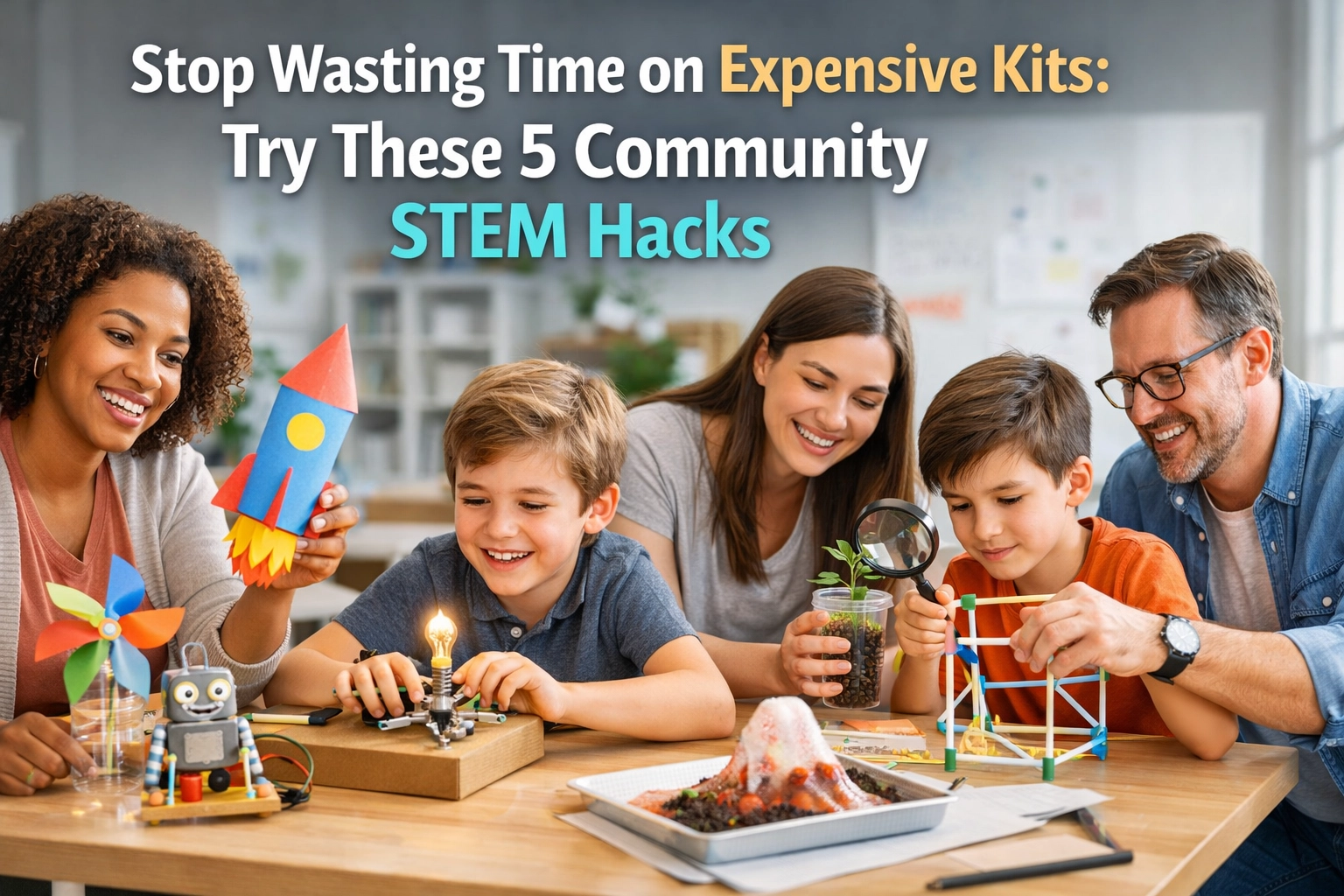

Let’s get real for a second. If you scroll through social media or walk down the toy aisle of a big-box store, you’d think that becoming a scientist or an engineer requires a $200 subscription box delivered to your door every month. You see these glossy kits with laser-cut wood pieces, pre-programmed circuit boards, and custom-molded plastic components. They look cool, sure. But here is the truth that the marketing teams won't tell you: Innovation doesn’t come in a box.
At Bindralearning Inc., we believe that STEM (Science, Technology, Engineering, and Math) isn't a luxury product. It’s a mindset. It’s a way of looking at the world and saying, "I can make this better." If you are waiting for an expensive kit to start your journey, you’re wasting time. The best laboratory in the world isn't in Silicon Valley: it’s right outside your front door, in your neighborhood, and inside your kitchen pantry.
For students in underserved communities, the "pay-to-play" model of STEM education is a barrier we want to break down. You don’t need a big budget to have big ideas. Ingenuity is about doing more with less. It’s about "hacking" your environment to find solutions.
Ready to stop waiting and start building? Here are five community-focused STEM hacks that cost almost nothing but will change the way you see your world.
1. The "Cardboard Infrastructure" Challenge
Most engineering kits give you specific pieces that only fit together one way. That’s not engineering; that’s just following instructions. Real engineering is about constraints.
Go to your local grocery store or check your recycling bin. Grab every cardboard box, toilet paper roll, and scrap of packing tape you can find. Now, look at your neighborhood. Is there a park that needs a better layout? A street corner that’s dangerous for pedestrians? A lack of community seating?
The Hack: Use your "trash" to build a 1:20 scale model of a solution for a local space.
- The Science: You’ll learn about structural integrity, load-bearing walls, and geometric stability.
- The Community Connection: When you build a model of a better bus stop or a safer playground, you’re practicing urban planning.
This isn't just a craft project. It’s a prototype. High-level engineers at companies like SpaceX and Google often start with "low-fidelity" prototypes made of cardboard and tape because it allows them to fail fast and iterate quickly.

2. The Neighborhood "Data Census" (No Computer Required)
Data science sounds intimidating, but at its heart, it’s just counting things and finding patterns. You don't need a high-end laptop or a subscription to expensive software to be a data analyst. You just need a notebook, a pen, and your eyes.
The Hack: Pick a "problem" variable in your neighborhood. It could be the number of plastic bottles on a specific block, the frequency of public buses running late, or the types of birds that visit a local tree.
- The Process: Spend 30 minutes every day for a week recording your data.
- The Analysis: Create a hand-drawn graph. Is the trash worse on Mondays? Does the bus always skip the 4:00 PM stop?
- The Impact: Take your findings to a local community leader or use them to fuel your next project.
When you track data in your own backyard, you aren't just doing math; you’re practicing Vedic Math principles of pattern recognition and mental agility. You are turning raw observations into actionable intelligence.
3. The DIY Water Filtration Station
Clean water is a fundamental right, but many communities face challenges with runoff or aging infrastructure. You don't need a fancy chemistry set to understand how filtration works. You can build a high-functioning filter using materials found in nature and your recycling bin.
The Hack: Cut the bottom off a 2-liter soda bottle and flip it upside down (cap side down).
- The Layers: Layer the bottle with coffee filters, crushed charcoal (from a BBQ pit), fine sand, gravel, and small rocks.
- The Experiment: Pour "dirty" water (mix tap water with dirt and leaves) through the top. Watch as the layers trap different sizes of debris and impurities.
- The Lesson: This teaches you about porosity, sedimentation, and the biological processes used in municipal water treatment plants.
While this DIY filter won't make the water safe to drink without boiling, it visually demonstrates the power of environmental engineering. It’s a direct link to our mission and vision of making science practical and accessible for everyone.

4. Kitchen Chemistry: The Red Cabbage pH Indicator
Who needs expensive litmus paper strips when you have a salad? Chemistry is happening in your kitchen every single day. One of the coolest ways to see it in action is by using a common vegetable to test the acidity of everything in your house.
The Hack: Boil red cabbage in water until the water turns deep purple. This liquid is now a pH indicator.
- The Test: Pour small amounts of the purple water into clear jars. Add different household items: lemon juice, baking soda, vinegar, laundry detergent, or even local tap water.
- The Reaction: The liquid will change color! Red/pink means it's acidic. Green/yellow means it's basic (alkaline).
- The STEM Shift: Instead of just "watching a reaction," start a log. Test the soil in your neighborhood's community garden. Is it too acidic for certain plants?
This is "Real-World STEM." You’re using organic chemistry to solve a biological problem (soil health), and it cost you the price of one cabbage.

5. The "Lightning Math" Market Challenge
Math is often the "scary" part of STEM, but that’s usually because it’s taught as a series of boring formulas on a whiteboard. In reality, math is the language of the street, the store, and the workshop.
The Hack: The next time you go to the local market or corner store, leave the phone in your pocket.
- The Challenge: Calculate your total, including tax and discounts, before you get to the register.
- The Strategy: Use techniques from our Lightning Math Enhancement Program. Look for ways to simplify numbers. For example, if something is $4.99, treat it as $5.00 and subtract a penny later.
- Why it matters: Fast mental math is a superpower. It builds the confidence you need to tackle more complex physics or coding problems later on.
When you master the math of your daily life, you stop being a passive consumer and start being a strategic thinker.
Why "Hacking" Matters More Than Kits
When you buy a kit, you are a consumer. When you hack a solution out of cardboard, cabbage, and community data, you are a creator.
At Bindralearning Inc., we are dedicated to fostering this spirit of innovation through programs like STEMTRAK4USA. We know that the next great invention won't necessarily come from someone who had the most expensive toys; it will come from the person who had the most curiosity and the grit to solve a problem with whatever was at hand.
If you are a student who is passionate about making a difference but worried about the costs of pursuing a STEM education, we want to help. We offer opportunities like the CSCRP Scholarship to support bright minds who are ready to change the world.

Your Next Step
Don't wait for a box to arrive in the mail.
- Walk outside.
- Find one thing in your neighborhood that could be improved.
- Use one of the hacks above to start investigating it.
STEM isn't a subject in school; it's the tool you use to build your future. Whether you are interested in Vedic Math or community engineering, the power is already in your hands.
If you have questions or want to share a project you’ve started using these hacks, we’d love to hear from you! Reach out to us through our contact page or fill out an enquiry form to learn more about our upcoming programs.
The world is waiting for your ingenuity. Let’s get to work.